There is a decision being made about your customers this quarter, and it is very unlikely that anyone made it on purpose.
Somewhere in your organization there is a rule that decides who reaches a human being. It might live in a routing table, a queue priority, an escalation threshold, or a line in a vendor's configuration screen. It was almost certainly written to manage cost and capacity. And without any meeting, any memo, or any strategy session, that rule has quietly answered one of the most consequential questions your brand will face this decade.
Who still gets a person?
The sorting nobody announced
For most of the history of service, the answer was everybody, eventually. If you waited long enough, a human picked up. The wait was miserable and the system was inefficient, but the door existed and every customer could find it.
That is changing, and it is changing unevenly. As automation absorbs the routine, human attention becomes the scarce resource in the building, and scarce resources get allocated. Some customers are routed to a person immediately, because their account is large, their tier is high, or their churn score crossed a line. Others are routed into a loop that has no exit at all.
Nobody stood up and proposed a two-tier service model. It assembled itself, one sensible optimization at a time.
What the customers already told you
Here is the part that should give a leader pause. In a Gartner survey of more than five thousand seven hundred customers, 64% said they would prefer companies did not use AI in customer service at all. Not that it works badly. That they would rather you didn't use it.
And when the same research asked what specifically worried them, the largest single answer, at 60%, was that AI would make it harder to reach a human when they needed one.
Read those two numbers together and the anxiety is not about competence. It is about access. Customers are not frightened that the machine will get their order wrong. They are frightened that the machine will be the only thing there.
Meanwhile Gartner projects that by 2029, agentic AI will autonomously resolve about 80% of common customer service issues, cutting operational costs by roughly 30%. Much of that is genuinely good. Nobody wakes up hoping to wait on hold for a tracking number.
But the collision is plain. The technology is heading toward a world where most contacts never touch a person, and the customers are telling you their central fear is exactly that.
The three questions your routing rules already answered
If you want to know what your organization actually believes about human service, do not read the strategy deck. Read the escalation policy. It has already made three decisions on your behalf.
First, who qualifies. Somewhere a threshold decides whose problem is worth a person's time. Account value. Tier. Predicted lifetime revenue. Ask what that threshold is, who set it, and when anyone last looked at it. If nobody in the room can tell you, it is being set by a default in a piece of software you licensed.
Second, how hard it is to get through. Some organizations offer a human immediately on request. Others make you fail at three automated attempts first. Both call themselves customer-centric. Only one is telling the truth. Time yourself getting to a person in your own system, using a customer's phone, on a Saturday.
Third, what happens when you get there. If the person who finally picks up knows nothing about the last twenty minutes, you have not given the customer a human. You have given them a fresh start they did not ask for.
A fair question about fairness
There is a reasonable business case for tiering. Airlines have sold priority queues for decades and nobody pretends otherwise. Private banking exists. Concierge medicine exists. Customers understand that paying more can buy faster attention, and stated openly, that is a bargain most people accept.
What customers do not accept is a hidden version of it. There is a difference between a company that says a premium tier includes a dedicated human, and a company that quietly routes everyone else into a system with no exit while its marketing promises that people are at the heart of everything it does.
The first is a business model. The second is a broken promise with a good user interface.
And here is the risk that never shows up on the savings slide. Your least profitable customer this year is somebody's most influential customer somewhere else. The small account is a chief executive's spouse. The low-tier subscriber writes a newsletter with forty thousand readers. When you decide who deserves a person, you are also deciding whose story about you gets told.
Three moves for the week
Find out who gets a person today. Pull the actual routing logic, not the policy document. Ask your service leader to show you the rule that decides which contacts reach a human. Then ask whether you would defend that rule out loud, to the customers on the wrong side of it.
Publish the door. Whatever your answer, make the path to a person findable and honest. A customer who knows they can reach someone in four minutes will wait four minutes. A customer who suspects the door has been removed starts looking for another building.
Set a floor, not just a ceiling. Most organizations define who gets premium human service. Almost none define the minimum every customer gets. Name that floor, write it down, and protect it against the next cost target, because the next target is always coming.
Reputations will survive this era wherever somebody decided, deliberately and in daylight, who still gets a person, and was willing to say so out loud.
So here is the question worth carrying into your next leadership meeting. If a customer of yours needed a human being this afternoon, could they find one? And would the answer be the same for all of them?
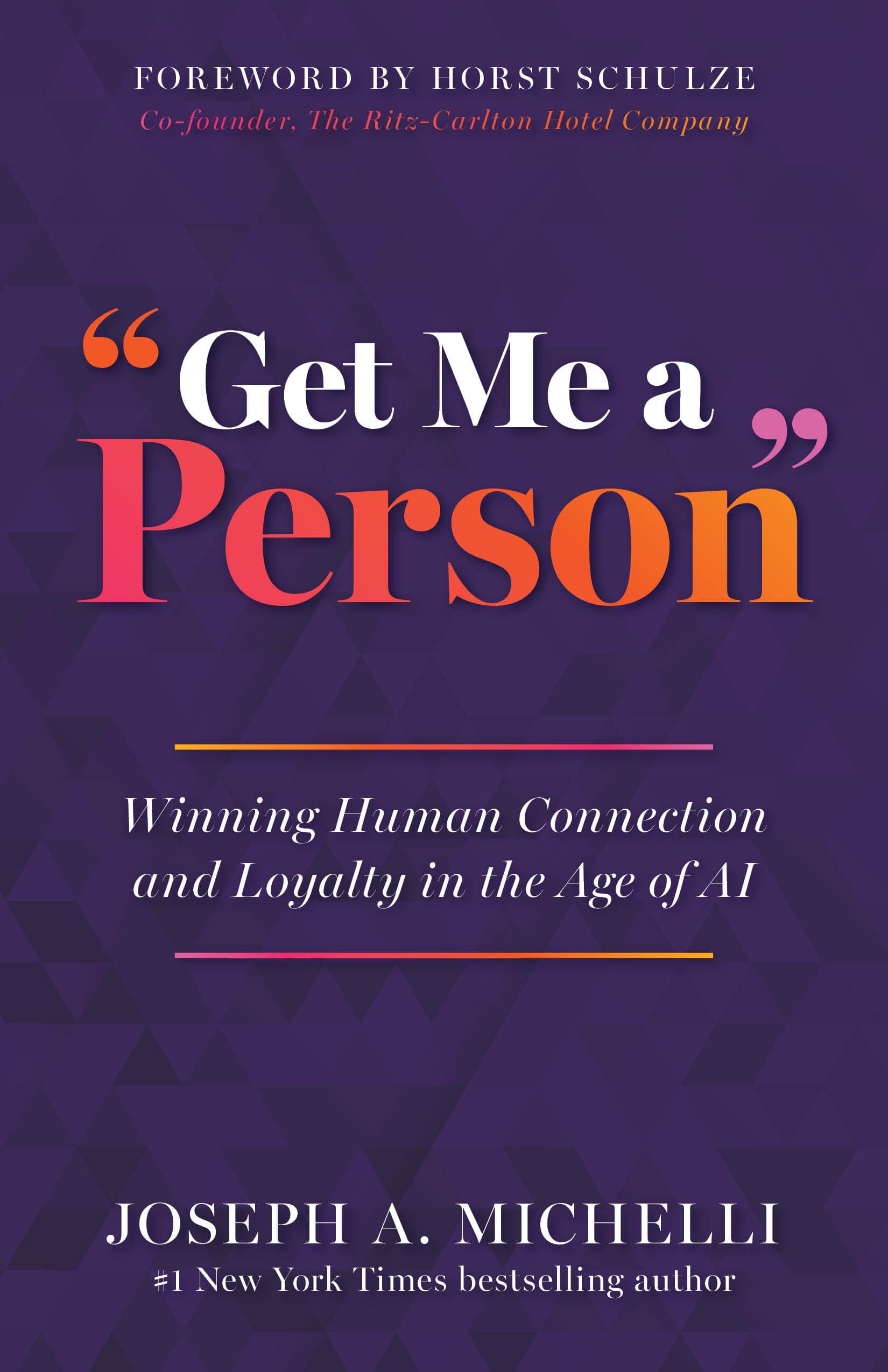
That is the subject of my new book. I hope you will consider purchasing Get Me a Person: Winning Human Connection and Loyalty in the Age of AI (December 8 — signed copies are available now). Also, if your team is deciding where the human line runs in your own service model, let’s talk.
Sources & references
- 64% prefer companies didn't use AI / 60% worried about reaching a human — Gartner press release, July 9, 2024 (survey of 5,728 customers, December 2023).
- Agentic AI to resolve 80% of common issues by 2029, ~30% cost reduction — Gartner press release, March 5, 2025.
- Tiered human access in airlines, private banking and concierge medicine — described as widely known industry practice, not as a statistic. No figures attached.