The business case will be immaculate. That is what makes it dangerous.
A smart team in your organization is going to automate a process this quarter that should never have been automated, and they will not be reckless about it. They will be doing exactly what they were asked to do. There will be a cost saving, a clean slide with an arrow pointing down and to the right, and a room full of people nodding. Then a few months later, without anyone quite connecting it, some of your best customers will start drifting away.
I have watched this pattern enough times to give it a name. I call it the Efficiency Trap: the moment a decision that looks obviously right on the spreadsheet turns out to be patently wrong for the human being on the other end of it.
The trap is worth naming right now, because the pace of automation is about to make it far easier to fall into.
The wave that's already here
This is not a someday conversation. Agentic AI has arrived in customer experience, and the numbers are moving fast. These systems don't just answer questions. They take action on your behalf.
In its 2026 State of Customer Experience report, drawn from thousands of consumers and more than 1,500 CX and business leaders across 20-plus countries, Genesys found that 40% of CX organizations are already using agentic AI. Looking ahead, 82% of leaders expect autonomous AI agents to orchestrate the customer experience within three years, and 86% expect AI to be part of every interaction by 2029. Read those three numbers together and the direction is not in dispute. The only open question is what a company decides to do with the time it frees.
Some of that is genuinely good. Nobody wakes up hoping to wait on hold for a tracking number, and if a machine can handle the routine flawlessly, let it. But speed and scale on this scale raise the stakes on a question most roadmaps never ask.
The question the roadmap skips
Here is the question I want to put at the center of every automation decision you make from here forward. Not "can we automate this?" The answer to that is almost always yes. The question is: who is this being designed around?
There are only two honest answers. Either you are designing the automation around the customer's experience and making their life genuinely easier, or you are designing it around your own cost line and hoping the customer won't mind. Both can wear the same language of "efficiency." Only one of them is safe.
And the customer can feel the difference immediately, even when they cannot name it. Genesys found the evidence sitting in consumer behavior: 85% of consumers say they have spent less with, or stopped buying from, a brand after poor service, and nearly half — 47% — say they would switch to a competitor after just two or three bad interactions with a brand they used to love. That is the Efficiency Trap in one statistic. The saving is immediate and easy to measure. The defection is delayed, diffuse, and almost never traced back to the automation that caused it.
How the trap springs
The Efficiency Trap has a signature. It shows up whenever a company optimizes the part it can measure and neglects the part it cannot.
Cost per contact is easy to measure. So is average handle time and the percentage of tickets "deflected" from human agents. That word should make us wince, because it describes a customer not getting to a person as a win. What is hard to measure is the frustration of a customer trapped in a loop, the erosion of trust when a system clearly cares more about closing the ticket than solving the problem, the quiet decision never to come back.
Genesys surfaced one detail that captures the whole failure mode: 48% of companies still do not pass information from their virtual agents to their human agents. That means nearly half of automated systems, when they finally hand a struggling customer to a person, hand that person nothing. Which ultimately translates into a customer that has to start over, repeating the whole story to a human who knows none of it. The company booked the efficiency. The customer absorbed the cost. That is the trap, running in production, right now, at scale.
Duolingo said the quiet part out loud
You do not have to imagine this. Watch what happened at Duolingo.
In April 2025, CEO Luis von Ahn sent an internal memo declaring Duolingo an "AI-first" company. The memo signaled that the organization would lean on AI wherever it could, phasing out contractors for work automation could absorb. On a spreadsheet, it read as disciplined and forward-looking. To the people who loved the brand, it read as something else entirely. The backlash was swift and public. Users flooded social media with variations of "AI first means people last." Some deliberately ended their hard-won learning streaks in protest.
Within about a week, von Ahn was walking it back, clarifying that AI would not replace what employees do and that Duolingo was still hiring. He later told a podcast that the memo had been misread, and the company dropped its AI-usage performance rule. Here was a beloved, technically excellent company discovering, expensively, that "efficient" and "loved" are not the same word, and that leading with the cost reduction story, rather than the human one, can lose the affection your brand runs on.
Duolingo did not fall into the trap because its technology was bad. It fell in because, for a moment, the automation story got told from the company's side of the counter instead of the customer's.
Getting out — and staying out
The way out of the Efficiency Trap is not to automate less. It is to automate on purpose, around human-centered needs.
Run the "designed-around-whom" test on every automation. Before you ship it, ask out loud: is this making the customer's experience better, or just making our cost lower? If the honest answer is only the second, you have not found an efficiency. You have found a future defection you have not paid for yet.
Protect the handoff. If you take one thing from the data, make it this: never let an automated system pass a customer to a human with empty hands. The moment someone escalates to a person, that person should have the full context. Fix that single seam and you defuse the most common way the trap springs.
Name the moments automation may never own. Decide in advance which experiences will always reach a capable human quickly: the complaint, the failure, the emotional or high-stakes moment. Then guard those moments against the next cost target, because the that next target is always coming.
Measure the defection, not just the deflection. If your dashboard celebrates tickets kept away from humans but never tracks whether those customers came back, you are managing the cheap half of the equation and flying blind on the expensive half.
Automate the right things, around the customer, and keep a capable human standing in the moments that carry weight. The alternative is celebrating savings on a slide while your best customers quietly do the math and leave.
So here is the question worth carrying into your next planning meeting. Think about the next thing you automate. Is it designed around your customer's experience, or around your cost line? Because your customers already know the answer. They just haven't told you yet.
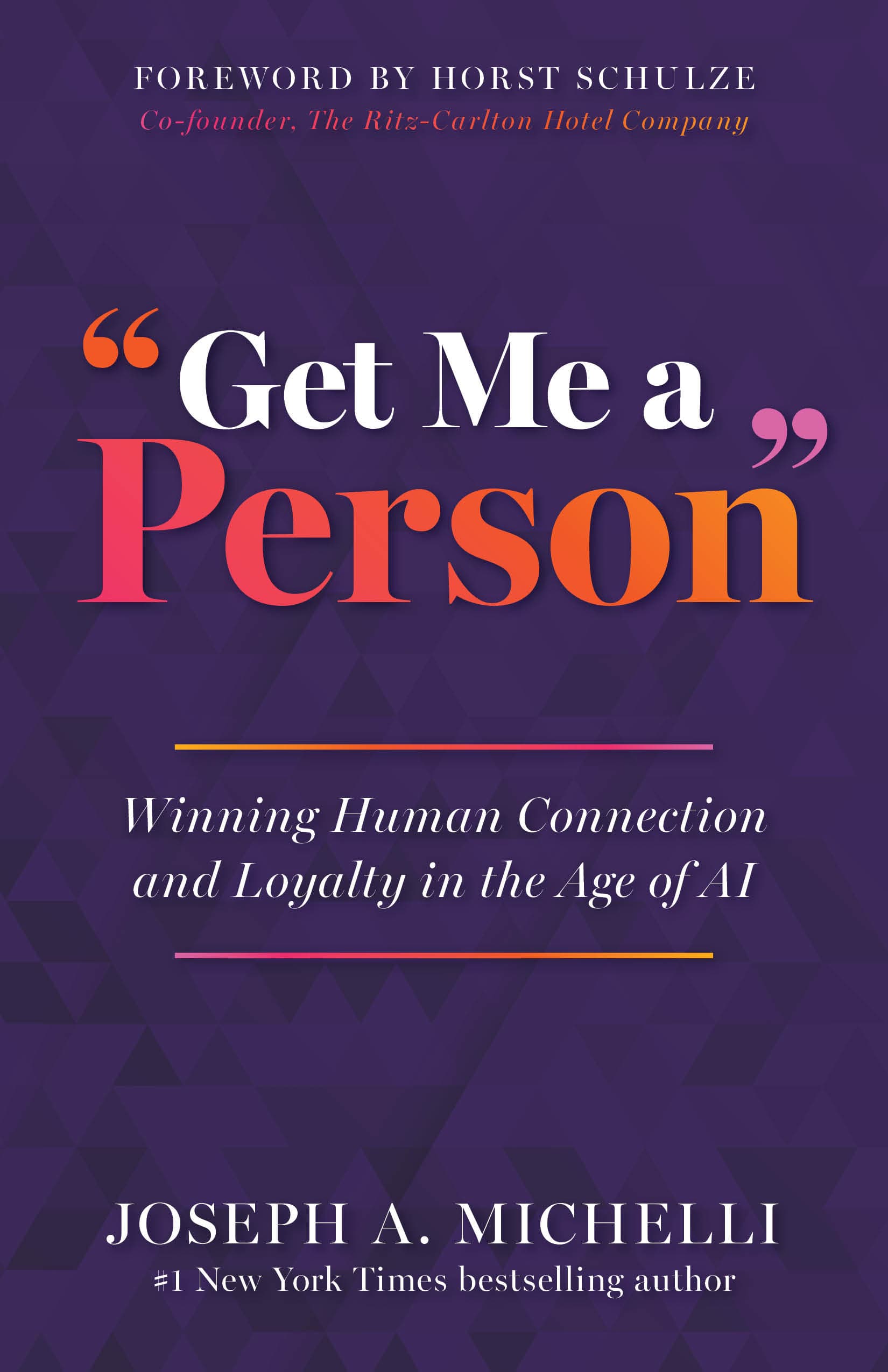
Spotting the trap is the easy part. Knowing which moments to defend when the business case says otherwise is the hard part, and it is what my new book is about. I hope you will consider purchasing Get Me a Person: Winning Human Connection and Loyalty in the Age of AI (December 8 — signed copies are available now). Also, if your team is deciding where the human line runs in your own automation, let’s talk.
Sources & references
- 40% of CX orgs already using agentic AI; 82% expect autonomous AI agents to orchestrate CX within three years; 86% expect AI in every interaction by 2029; 48% don't pass data from virtual to human agents; 85% spent less/stopped after poor service; 47% would switch after 2–3 bad interactions — Genesys, 2026 State of Customer Experience Report (survey of 5,811 consumers and 1,560 CX/business leaders across 20+ countries). genesys.com; report hub: genesys.com
- Agentic AI to autonomously resolve ~80% of common service issues by 2029 — Gartner press release, March 5, 2025. gartner.com
- Duolingo "AI-first" memo (April 2025), public backlash, streak protests, ~one-week walk-back, later dropped AI-usage performance rule — Fortune, Duolingo CEO surprised by backlash to AI-first announcement (June 9, 2025), fortune.com; PR Daily, Duolingo CEO walks back 'AI-first' memo (prdaily.com).