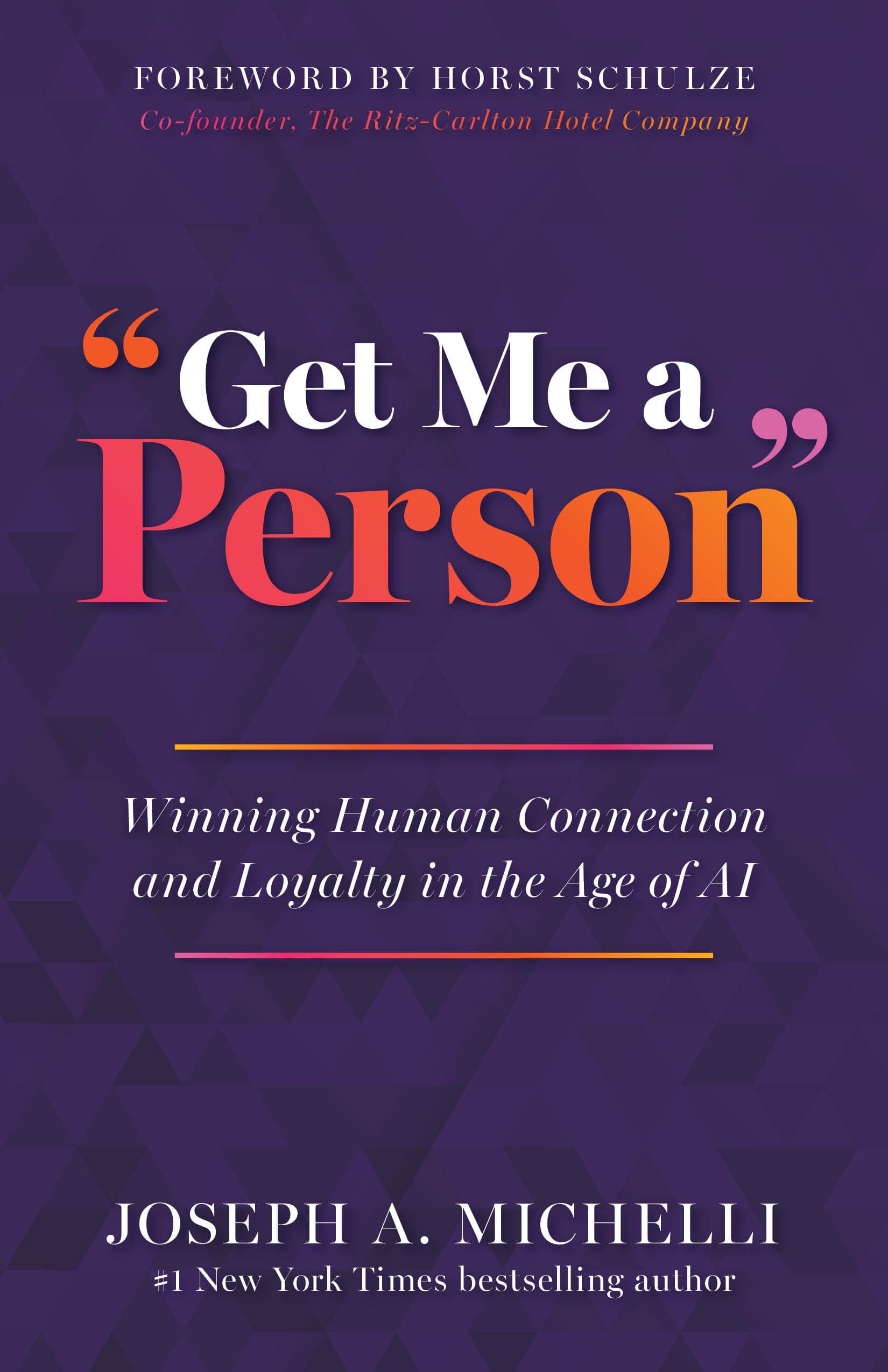
There's a moment that happens in almost every workplace, and almost no dashboard ever records it.
Someone does something quietly excellent. A nurse stays four extra minutes with a frightened patient. A barista remembers a regular's name and the hard week she mentioned last Tuesday. An engineer catches a flaw at 11 p.m. that would have cost a fortune by morning. And then — nothing. No one notices. The work disappears into the river of work, and the person who did it goes home wondering, in a way they'd never say out loud, whether any of it landed.
I've spent nearly four decades inside organizations famous for how their people show up — Starbucks, The Ritz-Carlton, Mercedes-Benz, Airbnb, Zappos, One Medical. And if you ask me what separates the cultures where people pour themselves into the work from the cultures where they merely complete it, it is rarely pay, and it is rarely perks. It's a much smaller, much more human thing. It is whether people feel seen.
That word matters, because we are entering an era where technology can watch your employees more closely than any manager ever could — and watching is not the same as seeing. I call the difference the seen/surveilled line, and it is the most important line a leader will draw in the next five years. Cross it the right way and your people feel noticed, valued, known. Cross it the wrong way and they feel tracked, scored, and quietly distrusted. Same technology. Opposite human result.
The cheapest engagement lever almost no one pulls
Let me give you the data, because the case for recognition is not a morale nicety. It is one of the highest-return, lowest-cost moves available to any leader.
In their joint research, Gallup and Workhuman found that employees who receive recognition that genuinely hits the mark are 73% less likely to "always" or "very often" feel burned out. They are 56% less likely to be looking for another job, and four times more likely to be engaged. Read that burnout number again. Not 7%. Seventy-three. In a labor market where burnout is bleeding talent out of every industry, recognition is one of the few levers that moves the needle that far, that fast, at almost no cost.
And here is the maddening part. The same research found that only about 23% of employees — fewer than one in four — strongly agree they receive the right amount of recognition for the work they do. So we have a lever that reduces burnout by nearly three-quarters, and three out of four people report it's barely being pulled.
The money follows the meaning. Gallup and Workhuman modeled that a 10,000-person company with a genuine culture of recognition could avoid roughly $16.1 million a year in turnover costs. A separate analysis estimated that doubling the number of employees who receive recognition could unlock nearly $92 million in additional productivity for a workforce of that size. Recognition isn't the soft stuff you get to after the real work. For the people doing the real work, it is the real work being acknowledged.
Why "scale" is where recognition usually dies
Here's the trap. The moment a leader sees those numbers, the instinct is to systematize recognition — to roll out a platform, a points economy, a badge, an automated "great job" that fires when a metric is hit. And technology genuinely can help recognition reach people a busy manager would otherwise miss.
But recognition has a strange property: the instant it feels automatic, it stops working. A thank-you that anyone could have triggered, that no one felt, is not recognition. It's a notification. People can smell the difference between I noticed you and the system noticed your number, and the second one lands with a faint insult — because it reminds them their number is being watched.
That's the seen/surveilled line in miniature. The same tools that can help you notice good work at scale can, with a small shift in intent, become tools that monitor people at scale. And employees feel that shift in their bodies long before they could name it.
The number that should give every leader pause
We don't have to guess at the cost of getting this wrong, because the research is sobering.
The American Psychological Association's Work in America study found that employees who feel monitored by their employer are markedly worse off than those who don't: 56% of monitored workers reported feeling tense or stressed during the workday, compared with 40% of those not monitored. In a more recent wave, large shares of workers said their employer tracks them, and roughly a third said they worry they're being watched in ways they don't fully understand.
Sit with that. The very tools sold to leaders as a way to "boost performance" are, for a meaningful slice of the workforce, manufacturing the exact stress that destroys performance. As a psychologist by training, I'll put it plainly: human beings have a finely tuned instrument for detecting whether attention is care or control. Surveillance triggers the threat response. Recognition triggers the belonging response. You cannot get the chemistry of belonging out of a system whose underlying message is we don't quite trust you.
The Ritz-Carlton lesson hiding in a story
Years ago, while writing The New Gold Standard, I watched The Ritz-Carlton run what they call the "lineup" — a brief daily gathering in every property, in every department, around the world. And a recurring feature of those gatherings is the sharing of "wow stories": real, specific accounts of an employee somewhere in the company who created an extraordinary moment for a guest.
Notice what that practice does. It is recognition at scale — it travels across thousands of employees and dozens of countries — and yet it never once feels automated, because at its center is a named human, a specific act, a real story. The system carries the recognition. It does not manufacture it. The noticing is still done by people, about people, for people. That is the whole secret. Technology should be the delivery truck for recognition, never the author of it.
Contrast that with a productivity platform that pings an employee, "You hit 100% of target — nice work!" The Ritz approach says we saw what you did and it mattered. The automated ping says we saw your number. One makes a person feel seen. The other reminds them they're surveilled.
Designing recognition that stays human
So how do you get the reach of technology without crossing the line? Three principles I'd put in front of any leadership team.
Make it specific, not generic. "Great job" is a notification. "You stayed with that scared patient when you could have moved on, and you changed her whole day" is recognition. Specificity is the proof that an actual human noticed. Technology can remind a manager to recognize someone; it should never write the words for them.
Make it about contribution, not surveillance. Before you deploy any tool that touches your people, ask the one question that decides which side of the line you land on: Is this designed to help us notice good work, or to help us catch bad work? Those two intentions feel completely different to the person on the other end — and they can tell, usually within a week.
Make peers part of it, not just the org chart. Some of the most powerful recognition doesn't come down the hierarchy; it moves sideways, between colleagues who saw the moment happen. Technology is genuinely good at widening that web — at letting a teammate three time zones away say I saw that, and it was excellent. That's scale in service of seeing.
The reframe that changes everything
Here is the shift I urge every leader to make. We've been taught to think of recognition as a reward — something you dispense for performance already delivered. Flip it. Recognition is an act of attention. It is the moment you tell a human being that their existence at work registered on you. Rewards are transactional. Attention is relational. And engagement — real, durable, customer-facing engagement — grows only in relationship.
The companies that will win the talent of this decade won't be the ones with the most sophisticated monitoring stack. They'll be the ones who used technology to notice more of the good, more often, more specifically — and who never let a single tool quietly slide from seeing their people to watching them.
So let me leave you with the question worth carrying into your next leadership meeting: every system you've deployed that touches your people sends them a message about whether they're trusted. If you asked your team, honestly, would they say your tools make them feel seen — or surveilled?
If you're not certain of the answer, that uncertainty is exactly the work I help leadership teams do. Come find me at josephmichelli.com/contact, and let's make sure your people feel noticed for the right reasons.